skip to main |
skip to sidebar
Delhi: Jan. 5 & 6, 2009
It had been two days since my last proper nights sleep. I had taken an overnight train from Varanasi to Agra, had a mad dash day of sightseeing, and then another train the same day to Delhi. Predictably, I slept very well my first night in Delhi.
I woke in the morning very refreshed and ordered my hot water heater be turn on. After a shower, I headed to the rooftop restaurant for breakfast. It was chilly in Delhi, in the low 60sF. While eating, I looked through my guidebook to come up with a plan for the next two days. Unfortunately, almost everything was closed on Monday (today... my one full day in Delhi). Oh well. There were still some interesting options. (View off the rooftop restaurant... cows, cows everywhere, and happily no beef to eat).  After eating, I headed down into the streets. My hotel was situated in the middle of the main bazaar of the Paharganj area. Basically, my hotel was built in the middle of an all day swap meet. By all day, I mean the vendors and their shops are open from before I rise until after I sleep. Thus it was extremely crowded and a constant barrage of touts were being shouted at me. I quickly found a place to call my sister and then the nearest rickshaw to escape. Click on the link to see a quick video on the tuk-tuk ride: http://www.youtube.com/watch?v=Xrr4QZzgv-k
My first stop was India Gate. It was beautiful somehow even though it is just a big arch. It is a 138ft tall, thick, memorial arch. The top is engraved, in English, dedicating the memorial in honor of more than 90,000 Indian soldiers that died in WWI. The arch was blocked off and protected by soldiers but you could get close enough. There were many students there who all wanted to take a photo with me. There is not much else there so I started walking down the street toward another sight. I needed to cross the street but there were no crosswalks and tons of traffic. India has many roundabouts where the traffic zooms by at top speeds with no thought to pedestrians, presumably engineered by the British. After waiting for a lull that never arrived, I just sprinted across the road with my fingers crossed.
Safely on the other side, I discovered a fort. By discovered I mean just that. It was not in the guide book, there were no signs or entrance fees, and I was the only person (besides a few young Indian men sketching it for art school. I met many young artists here drawing in various locations for school. We need more of that in the US.). So it was my fort and it was cool. There was a long wall and two crumbling buildings all made of rocks and red sandstone.  I climbed some of the stairs into little doorways and narrow halls. One set of stairs led to the rooftop which was brittle but safe enough if you stayed away from the edge.
 Exploring done, I crossed the street again to another fort. This one had already been discovered (dammit), named Purana Qila, and charged 100Rs ($2) admission. There were massive walls surround the whole area and three large, intricate gateways. It was built in 1540ish. There was a large mosque with many arches (and graffiti) and a large octagonal tower.
  When inquiring about a restroom, I was pointed down a path. I found the dirtiest bathroom I had ever seen. The interior was completely covered with black cobwebs and there were piles of human feces scattered about. It was so rad, I had to capture it on my camera. I later discovered a brand new bathroom down another path and was unsure as to why I wasn't given directions to that one.
 Exiting the fort, I hailed a tuk-tuk to Humayun's Tomb. The admission was 250Rs ($5). The park was large with many different structures with domes and arches, green lawns, palm trees, and waterways.
  The namesake structure was amazing. It was about the same size as the Taj Mahal and even more brilliant. There were some workers refurbishing the building on bamboo scaffolding.
 The tombs inside were intricately engraved white marble and the walls had many elaborate cutouts to let the sunlight in.
  Another quick rickshaw ride landed me at the Tibet House Museum. It was very small but had many huge woodblock paintings on hanging cloths telling the story of Buddha's life. There were also a few statues, military equipment, and money.
By that time I was getting hungry and, glancing through my guidebook, I noticed a 50's diner nearby and had to check it out. It was so bizarre. It was an exact replica... except filled with Indians. The employees wore 50's uniforms, there was a 50's jukebox filling the air, and all diner food on the menu. I noticed many tables discussing their confusion of various items ("Why would you want only the whites of the eggs?" "What is a malt?") .
Finally, I decided to head back to the hotel. There was standstill traffic (which was true every time I was in a rickshaw) and while stopped in the open tuk-tuk, I was approached by a woman with an impossibly large humpback asking for change. Once she left, a little girl approached, maybe 5 years old, asking for change. When she saw my water bottle she pantomimed to let me know she wanted some. She held her hand up to her mouth to use as a funnel so I would pour some in, which I of course did.
So here is the really depressing part of India, more noticeable in the massively overcrowded major cities: poverty. Two Indian facts: 41% live in one-room houses (not one bedroom... one room) and 40% earn less than $1 per day. The reality of this was heart-wrenchingly apparent in Delhi. I was constantly passing huge neighborhoods (yes, not just a house or two but whole neighborhoods) of people living in dirt floor cardboard houses with filthy barefoot children wandering about. Other major problems: sanitation and pollution. I constantly passed men urinating on the side on the road. All the streets had trash in them. The sky was always smoggy. Sewers were often overflowing. Many streets were just dirt.
Since my hotel was in the middle of a bazaar, the rickshaws are blocked from entering. So I hopped out at the market's edge and squeezed through the crowds and vendors toward my hotel. Of course I was dazzled by a few stalls and bought some souvenirs. Heck, when there are all these colorful, beautiful handicrafts for just $1 or $2, it's hard to pass it up. I relaxed awhile at the hotel and then decided to get a tuk-tuk to see an evening Indian dance show. I paid 200Rs ($4) and found a seat on a cozy velvet couch. The audience was sparse but the dances were wonderful.
There were 7 different dances from various regions of the country: some with 3 men & women all decorated, 1 with a man doing seemingly magical moves involving 3 sticks, 1 with a man dancing with an over-sized drum, 1 with a girl dancing while balancing 6 pots on her head and standing on swords, bowls, glass cups, and broken glass. The costume and makeup were beautiful. One dance included the young men wearing false mustaches and beards. Click the link to see some dance outtakes: http://www.youtube.com/watch?v=wlvNyCgZjWI I shared a rickshaw back to my hotel area with a couple from Portugal. While maneuvering through the market, a motorcycle ran into me. OOOWWW! It hurt really bad but I tried not to show it as I was surrounded. The driver apologized and went on his way. I hobbled to the ATM, bought some fresh off-the-grill cookies from a roadside vendor, and ate dinner. By the time I went to bed my calf had a huge painful lump. Great.
When I woke in the morning, my stomach was churning so I took some medicine as a precaution. As there are not many public restrooms, I did not want to take any chances. I ate breakfast on the rooftop restaurant and then got a rickshaw to Jama Masjid, the largest mosque in India. Admission was 200Rs ($4). It was built in 1658 by Shah Jahan (who conceived the Taj Mahal). It was a large rectangle surrounded by a wall with 3 large gateways, the mosque along the fourth wall, and a fountain in the center of the complex.  The mosque didn't have an interior just many arches over a carpeted walkway. There were some great views of the surrounding city though. And a few goats wandering around the outskirts.
 My last sight was the Red Fort, admission 250Rs ($5). It was huge area enclosed in an immense red wall with various buildings and gardens inside constructed by Shah Jahan.
  I hired a tour guide inside who explained the history. He examined all the carvings of each structure noting that they encompass all the religions of India.
  Shah Jahan lived here with his family until he was imprison by his son. They had very extravagant parties with musicians, dancers, and poets gathering around the fountains to entertain guests seated under delicate archways.
  After the British took over, there were large barracks built. My guide offered up much information about the succession of rulers and how each one eventually became corrupt. After my tour, I ran into 2 guys and a girl from Oregon. We strolled around the gardens awhile.
Exiting the fort, I bought a few very detailed paintings, one was on a leaf. While sitting on a bench out front, debating if I had time to go to another sight, I was approached by some Indian children. They were very cute and practiced their English on me. I was running short on time so I just headed back to my hotel, browsing the bazaar along the way. I had some dinner, checked out, and got a taxi to the train station.
My train to Udaipur left Delhi at 7:00pm and was scheduled to arrive at 7:00am (12 hours). I settled into my nice bunk with blankets and pillow. My bunk mates were a sweet Indian couple that spoke perfect English. They had even been to San Diego as that is where their daughter was living there. They shared some cookies with me. I was able to sleep better than previous trains because the final stop was Udaipur so I didn't have to worry about figuring out where to get off. The train ended up being 18 hours (again attributed to fog) and I arrived at 1:00pm.
Click the link to see the entire Delhi photo album: Delhi photos.
Stay tuned for Udaipur...
Agra: Jan.4, 2009
I took the night train from Varanasi to Agra. I left Varanasi at 5:00pm and I was supposed to arrive in Agra at 6:00am to see the Taj Mahal at sunrise. Unfortunately, due to fog, the train was barely moving and took 18 hours (instead of 13) so I didn't arrive in Agra until noon. It was actually okay with me because I was feeling weak and sluggish from having been sick and I was really not in the mood for sightseeing.
I disembarked from the train and went to the coat check to store my backpack for the day (10Rs: $0.20). An Indian guide found me and convinced me to take his day long taxi tour for 400Rs ($8). I agreed and once the taxi began moving, he started speaking and never stopped. Agra was very brown and dusty everywhere I looked.
Taj Mahal
Our first stop was the Taj Mahal. First you buy a pricey ticket for 750Rs ($15) (Indians only pay 20Rs ($0.40)). Then you go through security. You cannot bring in any electronics or lighters. I had to store some items in a locker. Once inside the area you first see a large red sandstone gateway. Through this are ornamental gardens and fountains leading to the Taj. Unfortunately, the day of my visit was overcast and I was unable to see the legendary reflection in the waterways and the lustrous glittering of the white marble. It was still beautiful though. Before climbing the stairs to the the Taj platform you either need to remove your shoes or put shoe covers on. Then there is a long queue to enter the Taj. About 90% of the visitors were Indian.
 My guide was very knowledgeable and spoke English very well but I forgot half of the information. The Taj was built as a monument to love. The mausoleum was built by the Emperor Shah Jahan for his wife that had died giving birth to their 14th child. Construction began in 1631. It took 22 years to complete and about 20,000 people helped build it.
 It is made completely of white marble with extensive inlaid designs and writings from the Koran made of precious stones. All of the marble was carried across the country by elephants. The entire structure and surrounding area is perfectly symmetrical.
  There are two red sandstone buildings on each side of it: one a guest house, the other a mosque.
  The tragedy is just after its completion, the Emperor was overthrown by his malicious son. The son killed his 3 older brothers and imprisoned Shah Jahan in the Agra fort where he could only gaze at his masterpiece until his death. Shah Jahan and his wife are both buried in the Taj. (The rumor is the son took power because he felt his extravagant father was wasting all the countries money. Plus the son was kinda evil.)
Behind the Taj Mahal is the Yamuna River and legend has it that the Emperor had plans to build and exact replica of the Taj Mahal in black marble on the other side of the river. Another legend is that the Emperor wanted to cut off the hands of the artists that did the inlay work on the Taj so they could not use their skills again. He finally decided to just cut off their thumbs and pay their families a settlement fee for losing their wage earner.
Leaving the Taj, I bought two bananas from a roadside fruit stand. I started peeling one and all of a sudden a gang of monkeys appeared out of nowhere and encircled me. My guide instructed me in a nervous voice to drop the banana quickly or they would attack. Even more monkeys appeared and I dropped it as fast as I could. They took it and and left. It was quite frightening and creepy.
Agra Fort
Next we headed to the Agra fort. It was built in 1565 and was mostly a military structure. It is very large and mostly built of red sandstone and some white marble. Back in its heyday, there was a moat around the immense structure that had crocodiles in it. Beyond the moat was a large red wall and further was the fort. The Emperor Shah Jahan lived in the fort with his family. Each of his two daughters had their own sections. There is a tower where the Emperor was later imprisoned by his son. Marble Artists
My guide took me to see how the artists made the precious stone inlays in the marble (like the Taj had). Although it was really just a trap to try and make you buy something it was still interesting. Two guys had spinning wood wheels and tiny pieces of stones. They first draw a design onto the marble and the carve it out. They choose the stones to fill the carvings and use the spinning wheel, water, and a wood tool to shape them. Using some kind of resin, they fuse the stones together and seal them into the marble piece. It seems like it would take forever to make one small plate nevermind decorating the whole Taj Mahal. Train Station: Agra to Delhi
My guide wanted to take me to more "artists shops" but it is really just a tourist scam and I wasn't in the mood. There were a few more sights I had wanted to see in Agra but I needed to get some food in me. I was just feeling really drained. I asked him take me back to the train station and I ate lunch in a restaurant there, retrieved my backpack, and waited for my train to Delhi.
While waiting on my platform, I people watched around the station. There were some old men working on the tracks below one platform with goats wondering around them. There were a few women and men that would race up to any arriving train and try to sell them food through the windows. The men had baskets on sticks they shoved toward the windows, while the women wore baskets upon their heads for passengers to reach in. Nervously, I witnessed many people crawling underneath trains as a shortcut to cross from one platform to another to save from having to walk up the stairs, the sane and safe alternative to crossing platforms.
There were many impoverished women with babies sitting on the sides of the walkways to beg for change from passersby. Dirt-covered children in rags also wandered around begging for change. Two of them teamed up to perform acrobatic stunts and then collect money from the audience. Once on the train and departing the station, we passed fields of trash piles with groups of children playing cricket or huddled around campfires. There were children as young as five just roaming around.
On the train, I shared my compartment with the most adorable Indian family. The mom, her two daughters, and a man (possibly her boyfriend) were so giddy. They played around and laughed the entire time. They didn't speak a word of English (and I don't speak Hindi) but somehow they made me a part of their family, buying me chai tea (from the guys who continuously roam up and down the train cars with their chai pots), offering me some of their dinner, taking photos with me, and helping me find my train stop.
They were so cute. At each stop they would run up to peer out the windows and scrutinize the station, debating with each other if it was my stop. They even recruited a man on the other side of the train to look out his window too. There was one person in my train car that spoke English and she talked to me for awhile. She said she would come back and let me know when the train reached my stop. Surprisingly enough, 5 hours later when we arrived, she came back and let me know, just as promised. My train arrived in Delhi at 9:00pm. I found a taxi to take me to my hotel, Hotel Rak International (the same as my very first night in India). Once checked in, I requested my hot water heater to be turned on and 15 minutes later, I showered. Then I passed out, exhausted and excited about exploring Delhi.
Click on the link for all the photos from Agra: Agra Photo Album
Stay tuned for Delhi...
Varanasi: Dec. 30, 2008 - Jan. 3, 2009
I landed in Varanasi in the afternoon. Thankfully, the hotel pickup was waiting for me. There were many Indians waiting for family members with marigold flower necklaces. We rode through the countryside with much greenery, shacks, and people.
It was a drastic shift once we approached the city. It was crowded and noisy. There were people everywhere: bicycles, motorcycles, cycle-rickshaws, auto-rickshaws (tuk-tuks), cars, trucks, people, cows. It seemed to be complete chaos, with constant honking, no lines, traffic lights, or stop signs, just go where and when there is a space. It was captivating and overwhelming. Hotel
Hotel
We stopped and I was led down some very narrow twisty alleyways to the hotel. The alley streets were tight and about 4 stories high on both sides with shops, houses, temples, people, cows, and dogs.  My backpack and I squeezed through them and finally reached the hotel. The hotel Alka is built right on the Ganges River and is a big U-shape with a large patio/restaurant in the middle. (It is the big white one). Click here to see a video of the view of the Ganges from my hotel: http://www.youtube.com/watch?v=ZUoylH27Wv0
 My room had a view of the river out the front door and a small balcony over the alleyways out the back door. It was great and 500Rs/night ($10). The restaurant at the hotel was delicious and had American and Indian food (all vegetarian). Most of my meals with drinks averaged 100Rs ($2).
I had two thick, heavy blankets to keep me warm at night. All the beds and pillows in India are hard. I slept fine but could hear people chanting and singing, monkeys fighting, and bells ringing at random times through the night. There are no shower curtains in Indian hotels (at least none of mine) so the whole bathroom gets wet. They have water heaters that you need to turn on and wait about 15 minutes before you want to shower.
The Indian people use the typical squat style toilets. You put your feet on the foot rests on each side and squat down. They clean themselves with water and their left hand. The hotels rooms, many restaurants, and tourist places have typical American sit-down style toilets although you often need to carry your own toilet paper.
Ganges River
Varanasi is one of the holiest Hindu cities and the Ganges River, the Holy Mother, is the most sacred river. Hindus believe the water has healing powers, if you bathe in it you will be washed of all sins, and if your cremated ashes are thrown in it, your soul will be liberated. Tens of thousands of Indian people come down to the river every morning at 4 or 5:00am to bathe and perform puja (blessing).
Every night from 6:00-7:00pm they return again for big ceremonies along the river called ganga aarti. There are young men that perform a choreographed dance involving bowing, waving incense, moving around burning candelabras, bell ringing, and chanting while the audience buys paper bowls containing marigolds and lighted candles and place them into the river as thanks. The audience surrounds the ceremony on the steps and in boats. Click the link to see quick video of the ceremony: http://www.youtube.com/watch?v=oYXAE-M2H_M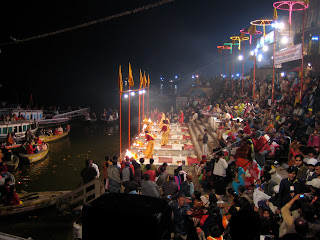 The river is actually very polluted but the people here will not admit it. Every person I spoke to denied that is was dirty. According to my guidebook, 30 large sewers are directly emptied into the river, the water is septic and has tons of fecal matter, waterborne diseases are rampant. One day I watched a dead cow floating down the river. Numerous times a day, I passed men urinating along the walkway right next to the river. Cows defecate next to the river and dead bodies and ashes are thrown in the river.
Climbing down the steps to the Ganges River, there is a walkway following the river with steps on one side leading down into the river and steps on the other side leading up to hotels, old maharajahs (kings) houses, temples, and streets to the markets and alleys.  With the overcast sky, the view was cut short but it was still lovely and peaceful.
 Within a few minutes, a young Indian man started up a dialogue with me and followed me down the river. This was a daily occurrence. Every time I left the hotel, within minutes, I had a young Indian male companion for the day. A few asked me at the end of the day to look at their silk shop but many just seemed to enjoy being a guide and would try to make appointments to meet with me the next day. One night, a young guy was trying to accompany me to the river ceremony and somehow I ended up in these dark alleys with no people around and the guy kept asking me if I had a boyfriend. I just kept quickly walking until I found a more crowded area and I ditched him.
The different sections of the walkways along the river are called ghats and each has its own name and story. One of the ghats had mats and wooden lounge chairs with umbrellas where you could talk to and be blessed by a Brahmin or holy man.  There were many colorful shrines along the walk
  and colorful rowboats going by (I took an hour long rowboat ride by myself for 50Rs ($1)). Click the link to see a video from the rowboat ride: http://www.youtube.com/watch?v=Wwnsn_hYH8c
 There were people everywhere in colorful dress along with numerous cows, dogs, goats, and a few monkeys. Many of the goats had sweaters on the people had knitted for them during winter. There were quite a few men building large, wooden boats along the walkways.
 Along the walk down the river, there were many people bathing in the river (they keep themselves covered), doing laundry in the river and drying their laundry by either hanging it or lying it on the ground, many people just sitting or lounging around, some selling jewelry. There were numerous children walking around selling postcards, bindi dots, candles for the river, and jars of colorful powder with stamps.
  There were many religious men, Sadhus (religious men that gave up everything and are possession-less and considered dead, some are even naked and covered in ashes (aghori))
 and Brahmins (like priests that will bless you and place a marigold necklace and talik (paint design) on your forehead, some dress in colorful costumes)
  and their followers are milling about.
  There were often homeless beggars sitting around. Kite flying was very popular with the kids. They were getting ready for a big kite competition in a few days.
Some Indian boys asked if they could take my picture. This, I would find out, is very common. Every city I was in, I was approached by Indians of all sexes and ages asking if they could take photos with me. I always consented.
The other side of the river has no buildings as this time of year it is exposed riverbed. During the monsoon season the river is higher but for now people were boating over to the dirt side and having picnics and flying kites and enjoying the open space they are deprived of. Cremation
I visited the Manikarnika Ghat, also know as the burning ghat. It is the most spiritual place for Hindus to be cremated. Upon approach, a guide immediately appeared to explain the ceremony to me. About 300 people a day are cremated here. There are two tall buildings behind the ghat which are sort of hospice houses; The elderly come there to die. Out of respect for the mourners, no photography is allowed in this area.
Once they die, the families get death certificates and cremation authorizations and then must buy the wood for the cremation. The wood is very expensive. They need like 200-300kg and each kg is 180Rs ($3.60). So the total price to cremate one person would be at least 36,000Rs ($720), which is the average yearly Indian income. (At the end of the "tour", the guide asked for donations that supposedly go to help families buy wood. I donated 100Rs ($2) and my guide, looking at me incredulously, said "this is the holiest, best, kind of karma you can buy. There is no way to buy better karma than this. The wood is very expensive." I gave him another 100Rs ($2) but refused more.)
The dead bodies are placed on platforms, decorated with gold foil paper and marigolds, and carried through the city. When they reach the Ganges River, they walk around the ghat 5 times with the body. It represents the 5 elements: water, air, earth, fire, and spirit. The body is then dipped in the Ganges before being placed on wood stacks for cremation. It takes about 2-3 hours for the body to burn. The ashes and any remaining bones are thrown in the Ganges River.
Women (of the mourning families) are not allowed to be present on the burning ghat as they begin crying and Hindus believe that creates a hold on the soul and it thus is not able to be liberated. The women have to stay back at the house.
There are 5 types of bodies that are not allowed to be cremated. The first 4 types of bodies are instead tied to a rock and thrown in the river. These are: women who died while pregnant (because they hold innocence in them), children (because they are innocent), victims of leprosy (because their skin is unclean), and Sadhus (these are religious holy men who have given up all their history and possessions and cannot be cremated). The last type of body that cannot be cremated are victims of cobra bites (because they contain poison). Their bodies are placed between banana leaves and floated down the river to the jungle where the residents pull the bodies out, remove the poison, and then tie a rock to the body and throw it in the river.
Monkeys
They were a few monkeys around. I often saw them climbing around the trees and the top of my hotel. They were usually fighting. One time there were monkeys climbing over the narrow alleyways and causing a disturbance. Another time, I tried to use the hotel's international phone to call Reina and it wasn't working.
"It's because of the monkeys," the man said.
"The monkeys?, Ha,ha," I replied but apparently he was serious.
"Yeah, they shake the wires at night," he explained. "They might be fixed tomorrow."
Click the link for some monkey fighting action: http://www.youtube.com/watch?v=xhbIaCJMI64 The Alleyway System
On the back side of the hotel is the crazy maze of narrow alleys. It is really amazing and beautiful. Click the link to see some scenes of the alleys: http://www.youtube.com/watch?v=JwEjTeKOKZw Everywhere you look is color, paintings,
  temples and shrines (by the way, there are swastikas everywhere. It is a Hindu symbol for the sun and the universe. I was told that Hitler stole it because he wanted to be more powerful than the sun. They were even on many souvenir items... uh, yeah, I can't walk around with a swastika covered journal in the US.),
  food stalls (they often serve food on leaves so you can just drop it when finished),
  chai tea (often served in plastic cups and clay cups that are just thrown into the street),
  silk shops, t-shirts, bags, statues, souvenirs. The alleyways are to tight for vehicles but an occasional motorcycle or bicycle will try to squeeze by. It is packed with people and the random cow, dog, or goat.
  The majority of the women wore colorful saris or shalwar kameezes and the men mostly had cotton pants and sweaters and some wore robes. Almost all the men wore scarves. The younger men often wore tight on the butt and flared leg pants and had their hair glamorously combed and were very seventies in general. Most of the men and women work taliks or bindis on their forehead.
 Weather
It was a little overcast and foggy each morning. The mornings and evenings were chilly, maybe 50F and the daytime got warmer up to somteimes even 70F and sunny with blue skies.
Economy
Just for comparison, I asked one gentleman accompanying me how much the average teacher here makes. He said about 3,000Rs ($60) a month. I asked how much rent is and he said about 2,000Rs ($40) a month. According to my guide book, the average wage in 2006 was $59 a year. I asked him what was a good job where you could make a lot of money and he replied that the only jobs that pay a lot are ones where you are doing something illegal.
New Year's Eve
I was watching the nightly Ganges ceremony when I noticed a group of teenagers lighting candles and pasting them to the ground to spell out 2009. A group of newspaper reporters were there and begged me to join them in the photos. Afterward, a Brahmin chanted with me, blessed me, and placed a marigold necklace around me and a large orange and red talik on my forehead.  Back at the hotel, they hosted a free party for all the guests. There were musicians playing drums and sitars (like a long skinny guitar with more strings) (click the link to hear a sample of the music: http://www.youtube.com/watch?v=TpbFwxMob1k ), a male and female dancer that did many dances (one of which was quite hilarious with high speed motions and some kind of funny chanting of "didja, didja, didja" that forced the audience to try to contain their laughter) (click the link to see a bit of the dancing: http://www.youtube.com/watch?v=QS2-v_DvOtw), and a flute band.
Afterward there was a huge buffet of delicious India food (all vegetarian of course, most Hindus are vegetarian and cows are sacred so you won't find beef in the entire country). They even gave us beer which is frowned upon by most Hindus. They had us hide it under the tables. I sat with a couple from Spain. Then they brought out a huge cake in the shape of 2009 and shot off a few fireworks.
Outer Varanasi Area
One day I walked outside the main ghats and alley streets and through the markets. Click the link to get a feel for the street chaos: http://www.youtube.com/watch?v=nLXM82e7-1E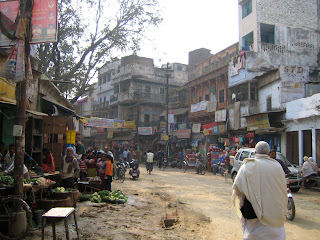 I walked down the larger main paved roads about 3 miles to a few different temples. At every temple it is required for you to remove your shoes before entering and no photography is allowed inside them. There is often a man to watch your shoes.
  They were all beautiful with many carvings and worshipers inside praying or being blessed or giving up offerings.
 Then I walked another 2 miles down to the Benares Hindu University. It covers a very large area and has many grassy parks and lots of space to breathe and escape the compacted city life. I went to a two story museum on the campus. Admission was 100Rs ($2) for foreigners (most places here have different prices for foreigners and Indians). There were many ancient statues, miniature paintings (the paintings are not actually minature but it refers to the amount of tiny details included in the painting), military equipment, letters from government officials, paintings on palm leaf strips, and some drawings and paintings from English artists that lived in India (as it was a British colony until 1947).
I had qualms about taking a cycle-rickshaw but then again, the peddlers are these old, scrawny men with no teeth and rags for clothes and all the Indians ride in them. It almost seemed like I was depriving the peddler of dinner by my choosing to walk so I finally caved in and took one from the University back to the river. Plus, it is better for the envirnment than the auto-rickshaws. For someone who looks like he is starving, they sure have a lot of strength and stamina. Getting Sick
According to my guide book, about 70% of the travelers to India get sick. It seemed accurate. In Delhi, I could hear the girl in the next room crying and puking. As I checked out of a hotel, a guy came down and asked to stay an extra day as his girlfriend couldn't leave the toilet. Every traveler I talked to had been sick, one girl even had to go to the hospital for dehydration.
Well, I was among them. My last night in Varanasi, my body woke me up and forced me into the restroom with nausea and more. I quickly took some medicine and tried to sleep. I had to get up again two more times but by morning I felt a little better. I decided to check out and take a cycle-rickshaw to the hospital pharmacy recommended in the guide book. The pharmacy gave me the medicine the guidebook recommended with no prescription but I was hoping to see a doctor to make sure that was the correct medicine. The place was confusing so I just paid for the medicine and left (The medicine was 86Rs ($1.70) and the cycle-rickshaw there and back was 150Rs ($3)).
Back at the hotel I looked the medicine up on the internet to make sure it was what I needed and to double check the instructions. I took one. I relaxed on the hotel baclony, enjoying the river, and praying I would be better as I only had about 3 hours before I needed to get on a 12 hour train ride. About 30 min. later, I had to puke. Unfortunately the restaurant restroom is the squat style toilet so I had to bend down really far and try to aim well. The entire pill came up with the few food I had left. Fortunately, it seemed to do the trick and I felt better.
Leaving: Train to Agra
The auto-rickshaw to the train station was 50Rs ($1). I had bought my train tickets in advance on the internet. It was very confusing at first but I found some helpful websites. The station was also confusing at first too. There are a few different platforms and you need to know which to be on (there are sometimes electronic billboards, announcements in Hindi and English, or a tourist office where they speak English). Once you find your platform, then you need to know which train arriving is yours. Once you identify that the train in front of you is the right one, then you need to find your train car and your seat. There are different classes of train cars you can buy tickets for. There are sleeper cars with beds in them and other cars with chairs. There are three different types of sleeper cars: AC2 is the best and most expensive. It has sealed windows and two beds per side that have enough room for you to sit up right and you get pillows, sheets, and blankets. The next class down in AC3. It is the same but has 3 beds per side (upper, middle, lower) and thus less room so you cannot sit upright without bumping you head. The final and cheapest sleeper class is SL. It also has 3 beds per side but the windows can open (which in winter means it is much colder) and you get no blankets.
I took one train in each sleeper class. The AC2 and AC3 had more people that were able to speak English. In the SL class I only found 1 person who could speak English. There are bathrooms (one squat and sit-down toilet) and a sink with a mirror between each car (the toilets just empty down onto the tracks below). Now you are on the train. How do you know when to get off? There are no announcements and most of the signs at the stops are in Hindi. Luckily I found other people to help me know when my stop had arrived. This meant my sleep was anxious and restless. You could sort of judge by how much time it was supposed to take but the trains were all running incredibly slow due to the fog. So my 12 hour night train to Agra was really 18 hours. That was fine with me as I just got to sleep more. Luckily my sickness had abated (I did throw up once on the train but overall felt fine).
Click on the link for the complete Varanasi photo album: Varanasi Photos
Stay tuned for Agra...
India: Dec. 27, 2008 - Jan. 15, 2009
I had always wanted to go to India and had some time off work so I decided to go. Unfortunately no one else I knew could get time off or didn't have money or the interest so I went by myself. I flew overnight from San Diego to Newark, NJ (about 5 hours) arriving at 5:00am. I had to take an airport train to another terminal and the first one I got in closed the doors and didn't move. I was trapped alone in a broken train. After a few minutes, I began to panic and pushed the emergency button. The doors immediately opened and I rushed out.
Then I took the shuttle to the hotel I had booked. I am not very good at sleeping on planes so I wanted to get sleep any chance I could. I closed all the blinds to the daylight and slept anxiously for 8 hours. That night, I awoke, showered, and took the shuttle back to the airport.
The flight to India was fine (about 13 hours). I read, watched a few movies on the little seat screen, and slept a few hours. Landing in Delhi was not as crazy as I thought. It was about 10:00pm and unfortunately my hotel pickup was nowhere to be found. After walking around to search and waiting awhile, I finally called the hotel and they told me to just take a taxi.
I headed outside to the taxi stand and hopped in. (It was 250 Rupees (Rs) ($5)). The driver spoke English so we chatted. Being nighttime, I couldn't see much of the sights but there was a lot of traffic and fog and it was chilly. There seemed to be road construction everywhere. There were many people on the streets. On the sidewalk of a busy street were a group of thin old men crouched in a circle with blankets wrapped around them. I tried to see what they were huddling around and my driver told me they were junkies sharing drugs. We passed a few cows and highly, colorfully, decorated hauling trucks.
We came to the road heading to my hotel and were blocked by an older Indian man.
"This road is closed. The whole neighborhood is closed for 3 days for a festival. You can't come down here," he gruffly informed us.
"But my hotel is there. How do I get to my hotel?" I asked.
"Go to the tourist office," he said.
So my taxi driver drove to the tourist office. Why would a tourist office be open at 11:00pm? Well, it was.
Before I continue I would like to describe my current state: I had been traveling now for 3 days, had little sleep and most of it fitful, hadn't had a real meal in too long, hadn't showered, it's almost midnight, and tomorrow morning I was going to be on another plane. So... all I really desperately wanted was a little sleep and a shower (I knew food would be a dream). On with the story...
The tourist office confirmed that the street was closed. They called my hotel and informed me that the hotel was completely full. Apparently my reservation meant nothing. They said they had problems with my hotel before. They offered to find me a new hotel but I told them I had no money. They said I could sleep at their houses with their families if nothing else came up. Then they said maybe I could change my morning flight to now and then wouldn't need a hotel. When calling the airline, I was informed that my flight was canceled due to fog. The tourist men kept changing the plan, didn't follow through with any of their ideas, and we were getting nowhere. I was very confused, frustrated, and exhausted and finally just walked out, got back in the taxi, and forced him to find another way to my hotel. Amazingly he did and the hotel had a room at their sister hotel next door. My hotel seemed be in a jungle of tiny alleyways. (The Hotel Rak International was 350Rs ($7)).
I took an uncomfortable hot shower (the shower head didn't work and the lower nozzle was waist high, so I had to shower sitting down) and tried to sleep although it was freezing. My growling stomach woke me up and I ate a few of the snacks I had. My deprived state was causing me to feel panicky so I just got up and dressed.
I took a taxi back to the airport. It was 7:00am and very foggy. There were many people already on the streets. Some huddled around fires they built. We stopped at a natural gas station to fill up. India is trying to work on its pollution problem.
After checking in at the airport, I read in the newspaper how the massive fog had pretty much closed the airport the day before and today flights were delayed (it was also causing trains to be cancelled and delayed). Luckily mine was only delayed about 1 hour. Whlie waiting, I got some food at the airport (there was a McDonalds, pastries, coffee, and sandwhich/snack stands). Then took the 1 hour flight to Varanasi.
 After eating, I headed down into the streets. My hotel was situated in the middle of the main bazaar of the Paharganj area. Basically, my hotel was built in the middle of an all day swap meet. By all day, I mean the vendors and their shops are open from before I rise until after I sleep. Thus it was extremely crowded and a constant barrage of touts were being shouted at me. I quickly found a place to call my sister and then the nearest rickshaw to escape. Click on the link to see a quick video on the tuk-tuk ride: http://www.youtube.com/watch?v=Xrr4QZzgv-k
 There is not much else there so I started walking down the street toward another sight. I needed to cross the street but there were no crosswalks and tons of traffic. India has many roundabouts where the traffic zooms by at top speeds with no thought to pedestrians, presumably engineered by the British. After waiting for a lull that never arrived, I just sprinted across the road with my fingers crossed.
 I climbed some of the stairs into little doorways and narrow halls. One set of stairs led to the rooftop which was brittle but safe enough if you stayed away from the edge.
 Exploring done, I crossed the street again to another fort. This one had already been discovered (dammit), named Purana Qila, and charged 100Rs ($2) admission. There were massive walls surround the whole area and three large, intricate gateways. It was built in 1540ish. There was a large mosque with many arches (and graffiti) and a large octagonal tower.
  When inquiring about a restroom, I was pointed down a path. I found the dirtiest bathroom I had ever seen. The interior was completely covered with black cobwebs and there were piles of human feces scattered about. It was so rad, I had to capture it on my camera. I later discovered a brand new bathroom down another path and was unsure as to why I wasn't given directions to that one.
 Exiting the fort, I hailed a tuk-tuk to Humayun's Tomb. The admission was 250Rs ($5). The park was large with many different structures with domes and arches, green lawns, palm trees, and waterways.
  The namesake structure was amazing. It was about the same size as the Taj Mahal and even more brilliant. There were some workers refurbishing the building on bamboo scaffolding.
 The tombs inside were intricately engraved white marble and the walls had many elaborate cutouts to let the sunlight in.
  Another quick rickshaw ride landed me at the Tibet House Museum. It was very small but had many huge woodblock paintings on hanging cloths telling the story of Buddha's life. There were also a few statues, military equipment, and money.
 I relaxed awhile at the hotel and then decided to get a tuk-tuk to see an evening Indian dance show. I paid 200Rs ($4) and found a seat on a cozy velvet couch. The audience was sparse but the dances were wonderful.
 The mosque didn't have an interior just many arches over a carpeted walkway. There were some great views of the surrounding city though. And a few goats wandering around the outskirts.
 My last sight was the Red Fort, admission 250Rs ($5). It was huge area enclosed in an immense red wall with various buildings and gardens inside constructed by Shah Jahan.
  I hired a tour guide inside who explained the history. He examined all the carvings of each structure noting that they encompass all the religions of India.
  Shah Jahan lived here with his family until he was imprison by his son. They had very extravagant parties with musicians, dancers, and poets gathering around the fountains to entertain guests seated under delicate archways.
  After the British took over, there were large barracks built. My guide offered up much information about the succession of rulers and how each one eventually became corrupt. After my tour, I ran into 2 guys and a girl from Oregon. We strolled around the gardens awhile.


